Sideways to Heaven: A Baltimore Image Journal
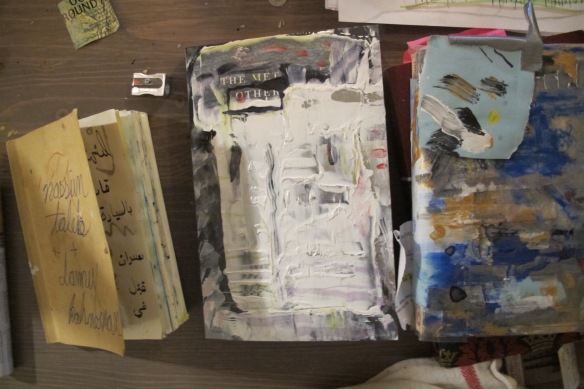
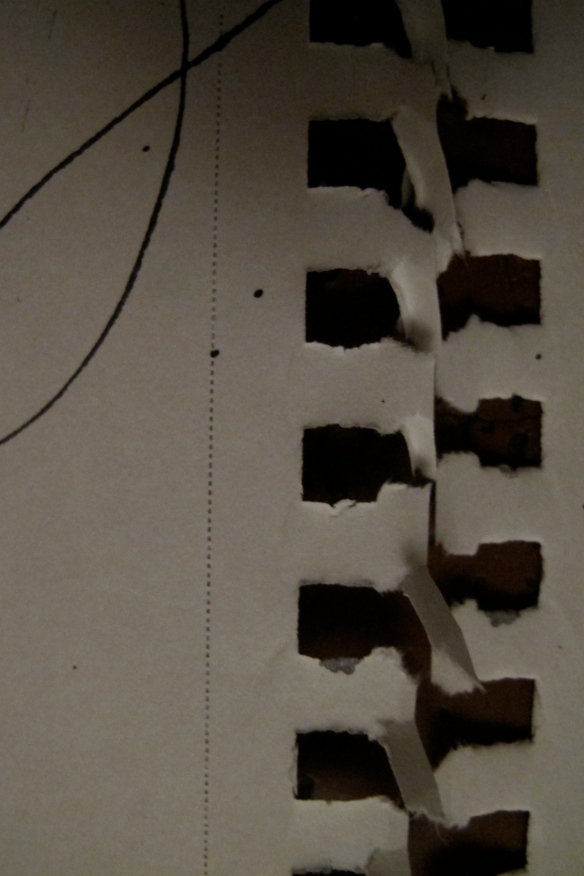
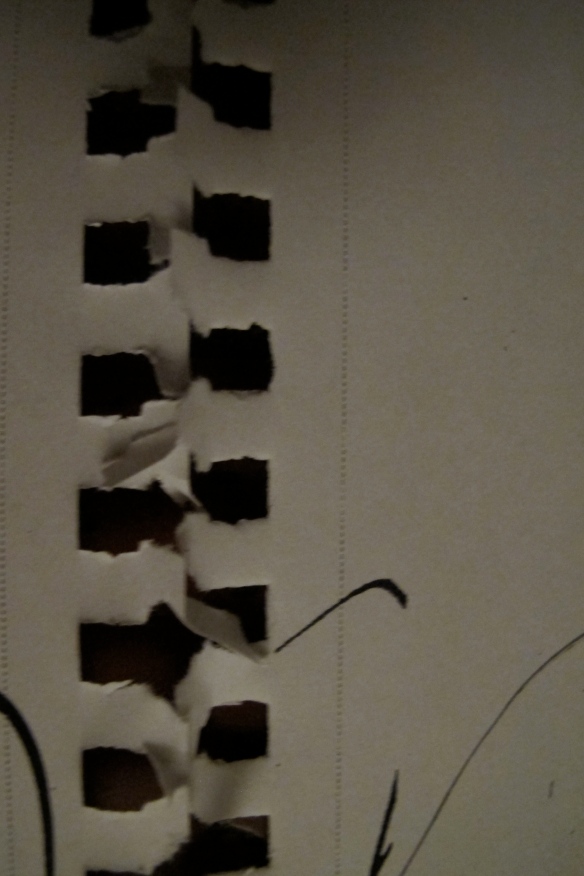
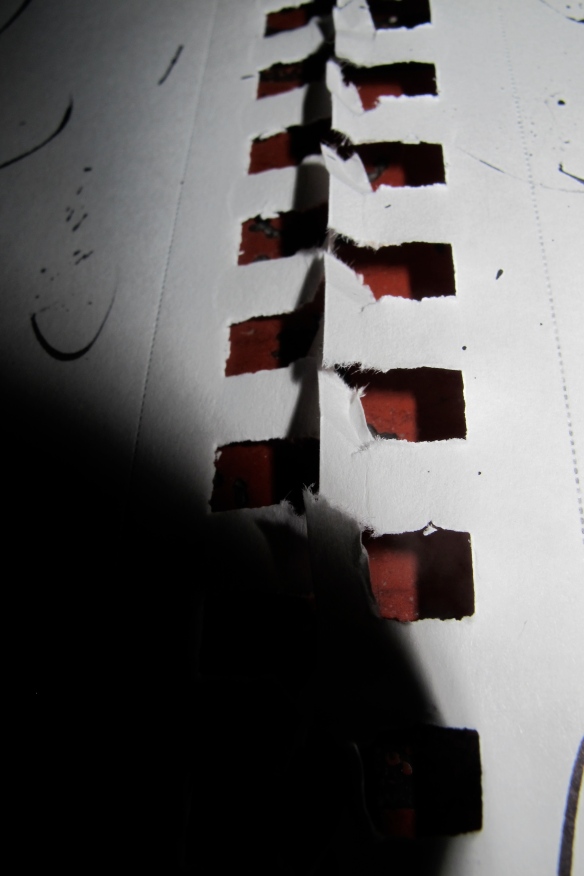
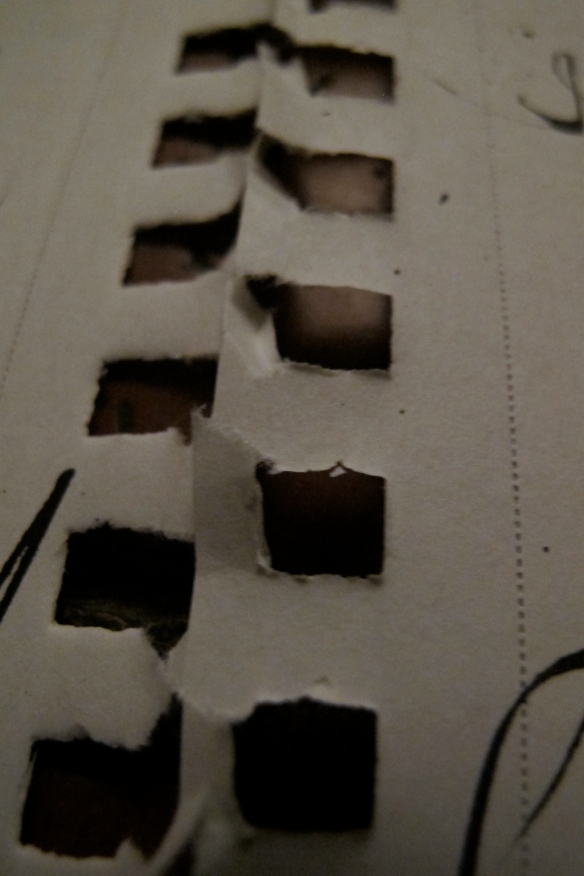
This is a pictorial journal of the past few days. It began in Baltimore where I found this pizza box thrown up against a cinderblock wall and was provoked to imagery. The box seemed to be saying, “Go to hell.”
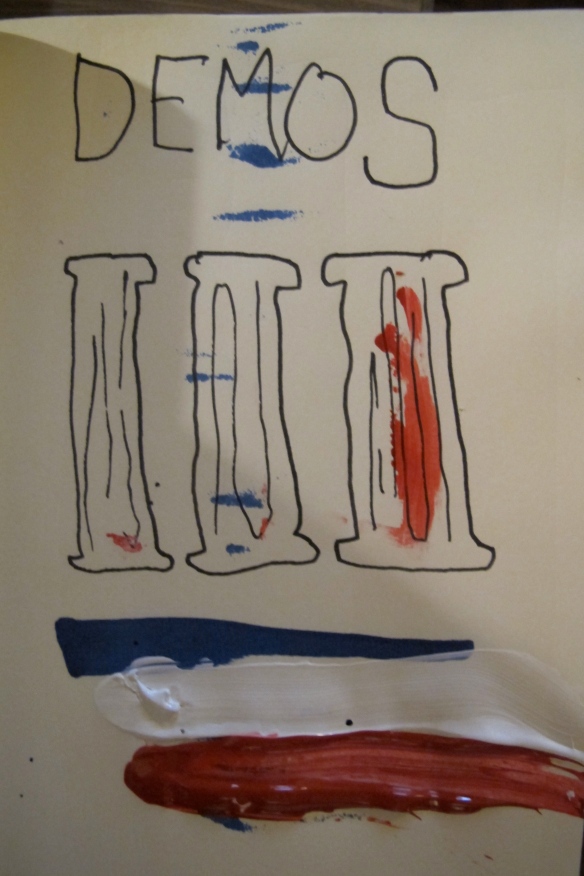
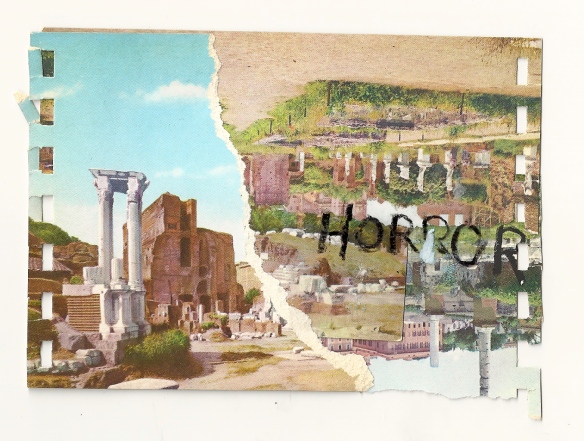
(Fig. 2) This is an image inspired by the Towson Town Center mall. It was conceived across the street, in a lesser mall but with a good vantage point. It seemed that telecommunications were the real power source along the street and feeding into the mall – it’s probably underground coaxial cable, but the wires and poles remain (which makes sense because these are the recent ghosts of 20th century technology). Anyway, I had been fixated for some time in my work on ‘the pillar’ (as an over-invested image which stood so far apart from what it was claimed to represent) and so these old poles really dominated the tableau. Towson is kind of a model for the way the new ruthlessly obliterates the old in this country – everywhere there is evidence of shoddily achieved replacement. Thus, the recent and the old are pretty easily seen crumpled up beside or around the latest new (which in Baltimore looks like 1987). Confronted with such glaring contradictions, would one not elect for the highest Roman distinction?
(Fig. 3) This is a counterpane to Fig. 4 (“Philly’s Best Go to Hell Bell”). It was meant to be the flames leaping off the menu of Philly’s Best, an Indian pizza sub hoagie restaurant in Baltimore. But it became mired in amoebic dysentery.
(Fig. 4) This is the bell from the cover of the Philly’s Best menu. It reminded me of the fiery rhetoric of the 7-11 pizza box I had misread in Fig. 1. “Go to hell.” That’s what these things said, but in lovingly bereft ways. They might have been on the side of those gone to hell – they were used up, left over, discarded. Like the emotional currency of images like the liberty bell or the pillar of democracy.
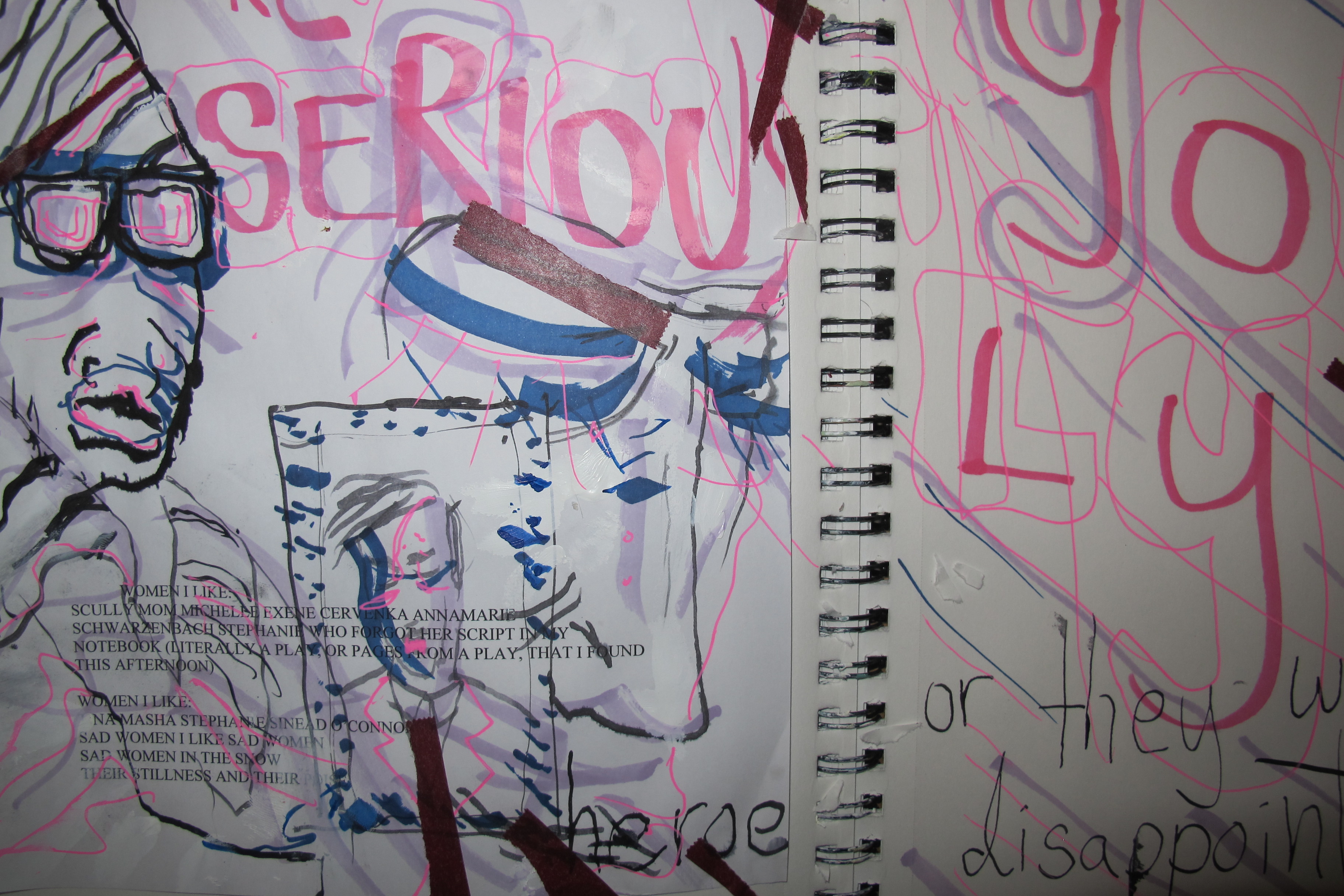
(Fig. 5) Here I hit my stride. The various strands of the previous images – the provocations and brutal sadness that they broadcast – found a kind of redress in this picture. The rupture appears to have come from within. It contaminates the as-yet-unafflicted pillar to its right. The sheer physicality of this work was a pleasure to produce – I was using a broken chopstick (from Asian Taste) to striate the drawing.
(Fig. 6) Upon returning home I was haunted by images garnered in the other city. A series of vanquished strivers ensued. One begot the other, largely through the use of my favorite tool, surface and medium: the high quality paper towel.
The images grew more Blakean and symbolically unstable as the impulse to reproduce became implacable.
I was running the stations of the cross: brush, paper towel, ink, iPhone, computer, palette knife, and back again, amidst a profusion of ghostly strivers. The images became more confounding and spiritual. It felt like the hyperspace that Fredric Jameson describes in his “Postmodernism” essay. An essay you’ll want to have in hand should you ever seek to penetrate the beguiling veldt of the Towson Town Center Mall.
Who is speaking here, the right-flying angel or a dubious god?
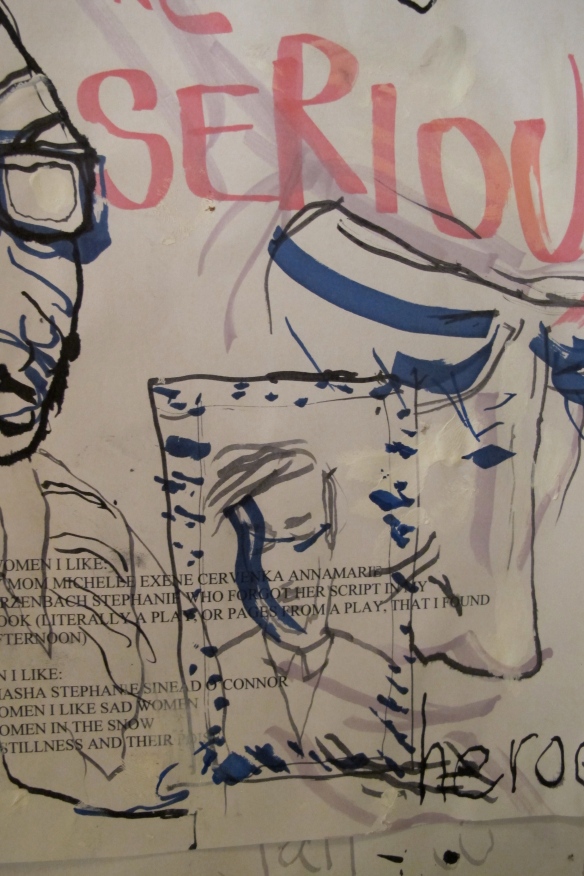
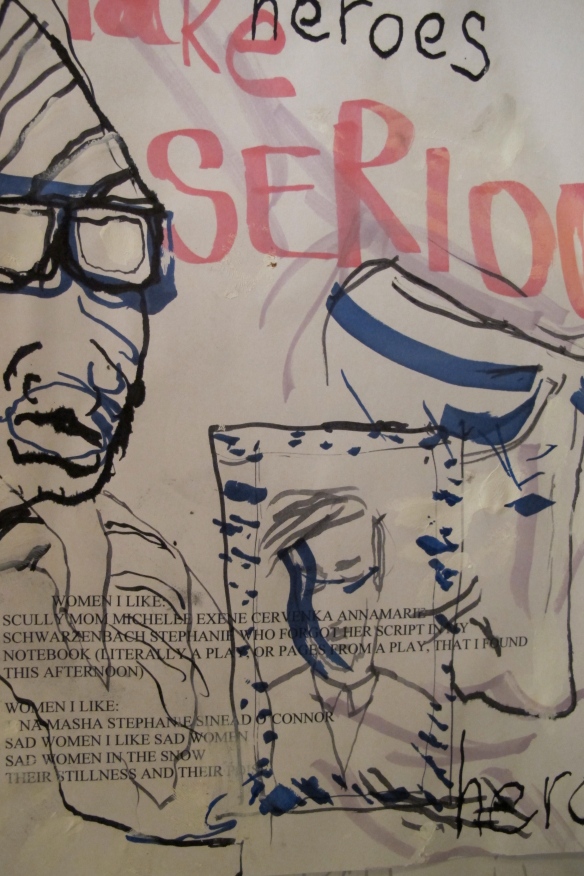
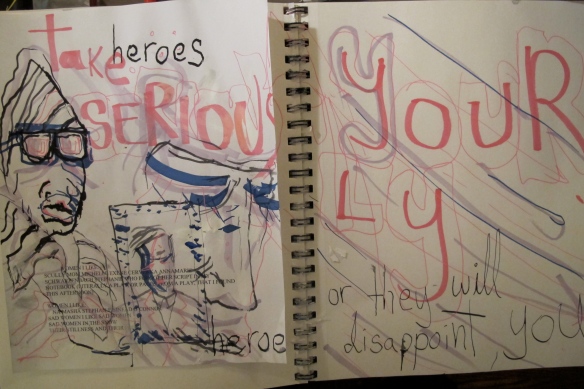
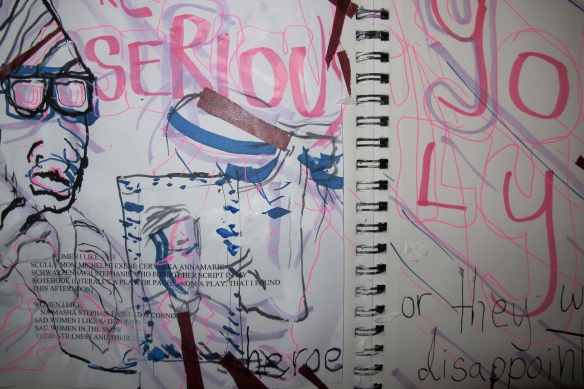
This image reflects the beauty of the many people I saw and met in Baltimore.
New Work: “Same Changing City”
Profiles in Death : The West
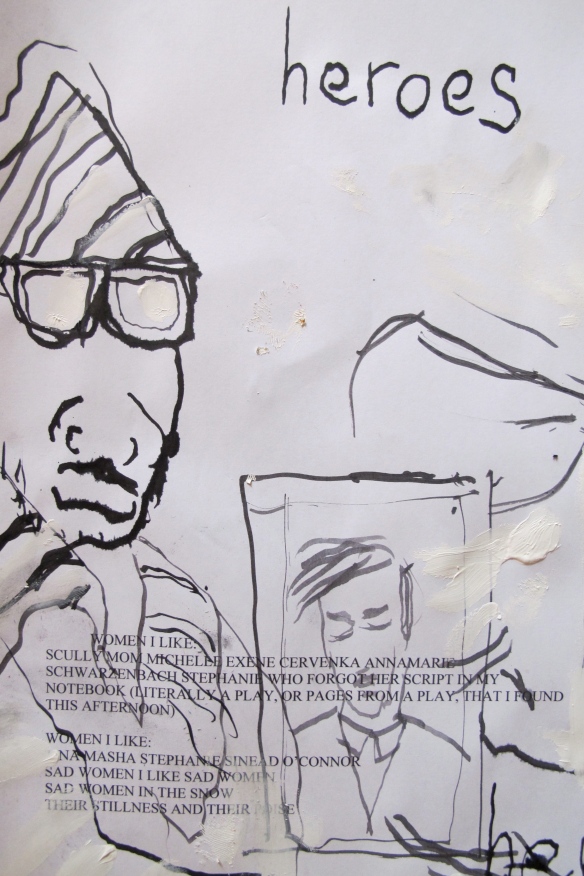
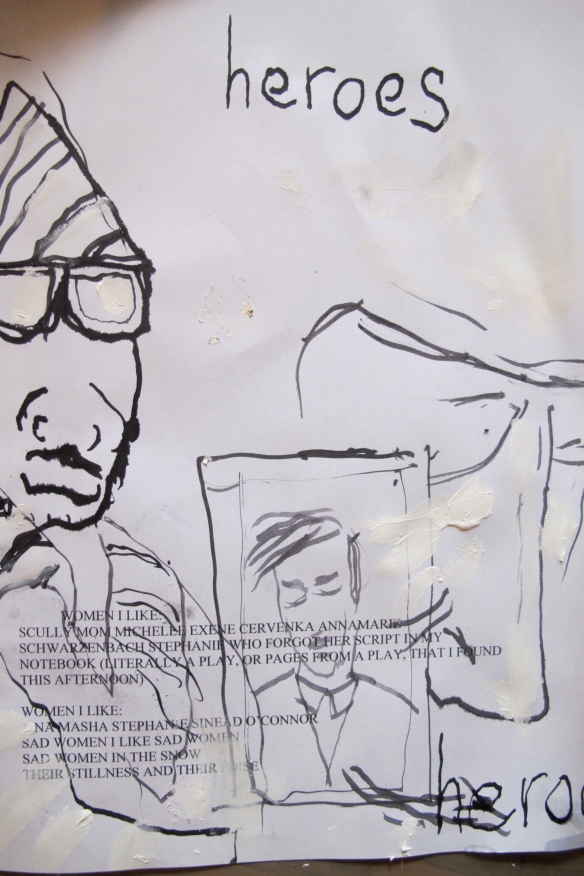
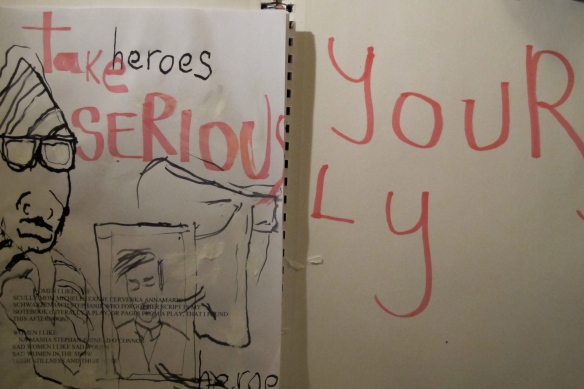
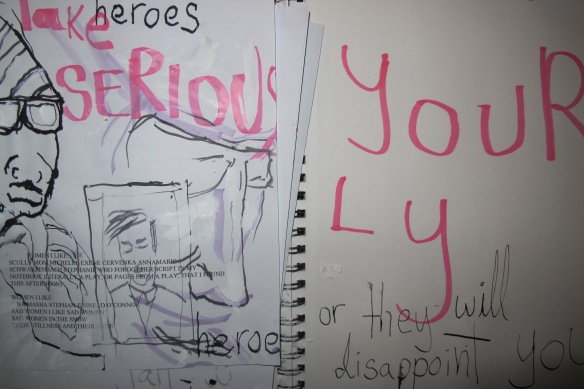
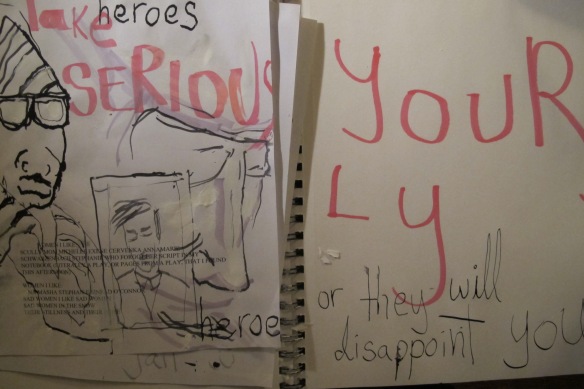
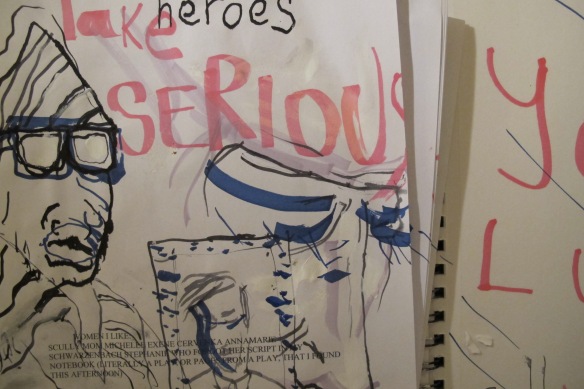
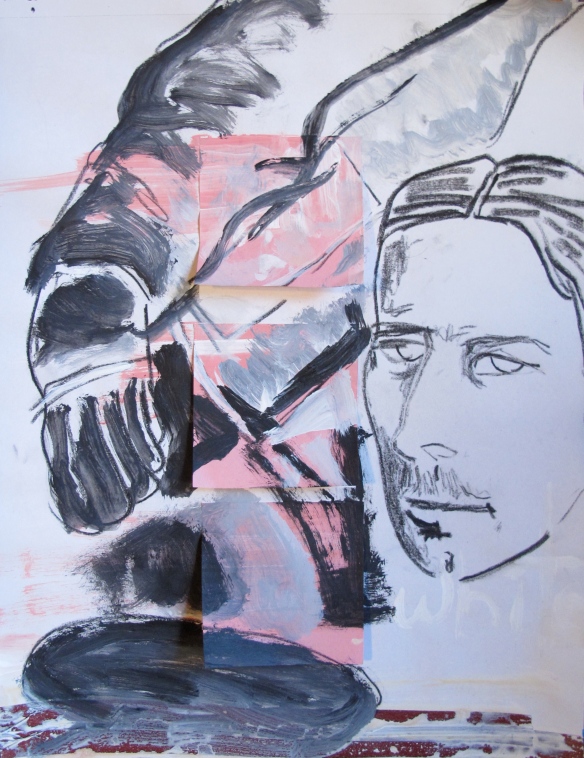
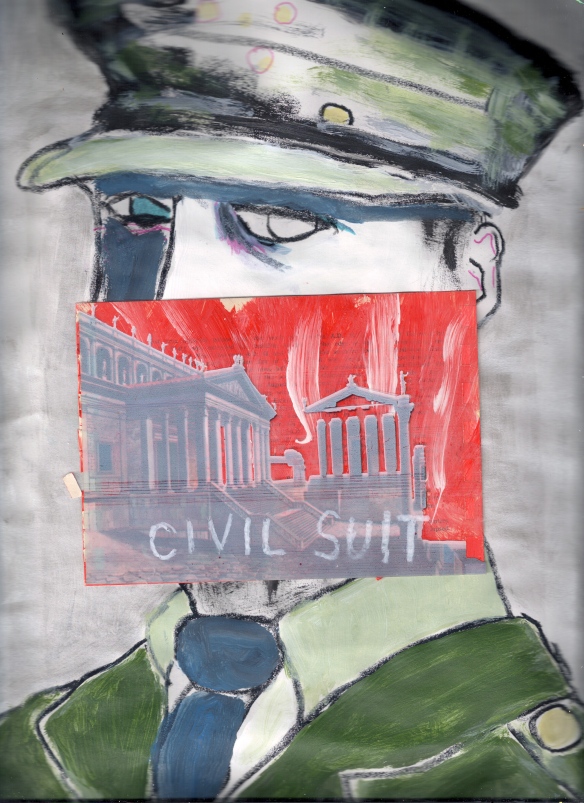
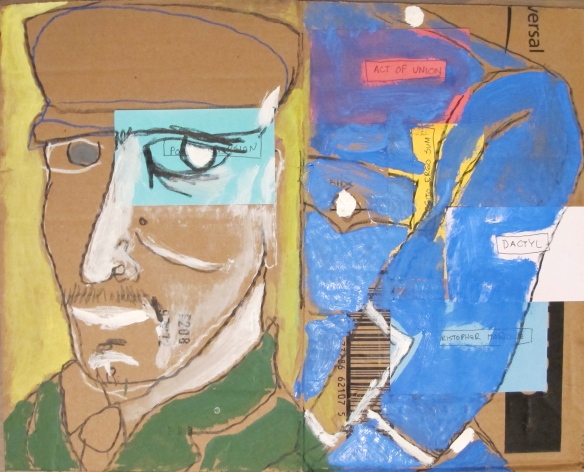
Chris Lager’s startling portrait of western civilization in its latest state of agonizing civil war and decline was auctioned this week on ebay for the record sum of $28 (USD). Persons close to the Lager estate have refused to comment. All, that is, save for Lager’s fond uncle, Demetrius Lager, who spoke to the Catastrophe under condition of anonymity about the generative compositional latex and popsicle-stick moment: “Chris was so happy then. He would exercise, eat vigorously, and then swear push-up oaths against the blasphemy of the emerging theo-capitalist populism. I remember one day, we had just returned from a breathless hike along the toes of the Jura range — Chris fell to his polenta and began shaping southwestern mountains, death’s heads, and what he called ‘Heroes of Capital Punishment’ on his plate. The painting appeared, presented as a gift to herr Lager and myself, later that same afternoon.”
The Wells Connection: Part II of the Catastrophe’s exclusive coverage of USS Nostromo’s abrupt “Irish Exit”

The remains of Dallas Wells' surfboard, photographed during the legendary 50-year swell ("Fat Tuesday" to locals) off the Flemish Cap in 2079. (Dutch authorities have expressed shock over what they term Wells' "outrageously unlimited uncanny omnipresence.") Wells, investigators say, may be the pivotal key to finally understanding the Nostromo's recent misadventure.
In addition to being the Nostromo‘s acting captain, Dallas Wells was also a legendary surfer. Since America’s largest commercial fishing vessel/ore & droid-hauler went missing east of the Flemish Cap this August, a number of hardcore surfers have begun posting photos of Wells in his pre-Company youth. It has since come to light that Wells once attempted a tow-in ride at the Cap itself, twenty years before his Nostromo – it would now appear to be certain — ran fatally to ground in August of this year. (The Cap is renowned amongst big wave riders for its incredible “left/right break” and “enormous bowl section,” which owe something to the ponderous volcanic and tectonic formations that make up the Mid-Atlantic Ridge beneath her waves.)
Lieutenant Colonel William Kilgore, who mentored Wells’ wave riding as a teenage soldier, was there that day on The Cap: ”He was a natural. He had that perfect blend of half-stoke, half-oblivious. And when he got on those waves it was just…pure madman. He was what we in the tribe call a seeker. I watched him fall 80 feet that day, down the face of a white wall of unbridled oceanic death. His board came up in splinters. Three waves later, out of nowhere, Wells pops up whooping and hollering like a fucking wolf with a metal dick. No fear – do you see what I am saying? Man, I miss it…” (Kilgore is probably best known for taking and holding the coastal mouth of the Nung river for over six hours with his elite “Air Cavalry Division” during the Occupy Southeast Asia movement of late ’71.)

Wells' iconic 2072 photograph, shot while standing on the skid of Kilgore's Bell UH-1N ('Huey') during a classified "Napalm run" over Cambodia. (In the middle distance one can discern the anachronistic shock of a Boeing Vertrol CH-47C Chinook.)
Flemish authorities have expressed puzzlement over the revelation of Wells’ early history with The Cap. Brent Lindqvist, a Marine Safety inspector and forensic pathologist with the Dutch Corps of Engineers, had this to say: “It suggests a terrifying historical nexus of ‘power interests’ between military, corporate, and theological factions within the U.S. Why was this maverick returned to a site of such devastating psychological humiliation? Where did the so-called ‘distress signal’ emanate from, really? These are questions that are being asked on the streets and in the canals of our capital city of Amsterdam.”
After completing undergraduate studies at UC Chico, Wells rapidly accelerated through the United States Navy Strike Fighter Tactics Instructor program (SFTI) in Miramar, California, where he became chief instructor in 2081.
And then Wells — nearing the summit of what looked to be a spectacular career trajectory — suddenly left the program citing only “fatigue” in his resignation letter. (SFTI insiders say that it was, in fact, the loss of one of his prized cadets to a Russian MIG-29 [or "Fulcrum"] fighter over the Indian Ocean that prompted Wells to wash out.) He spent the next several years surfing the Mentawai Islands, Indonesia, El Salvador, Gold Coast, Australia, Bali, Costa Rica, as well as the native breaks of his home state, California.

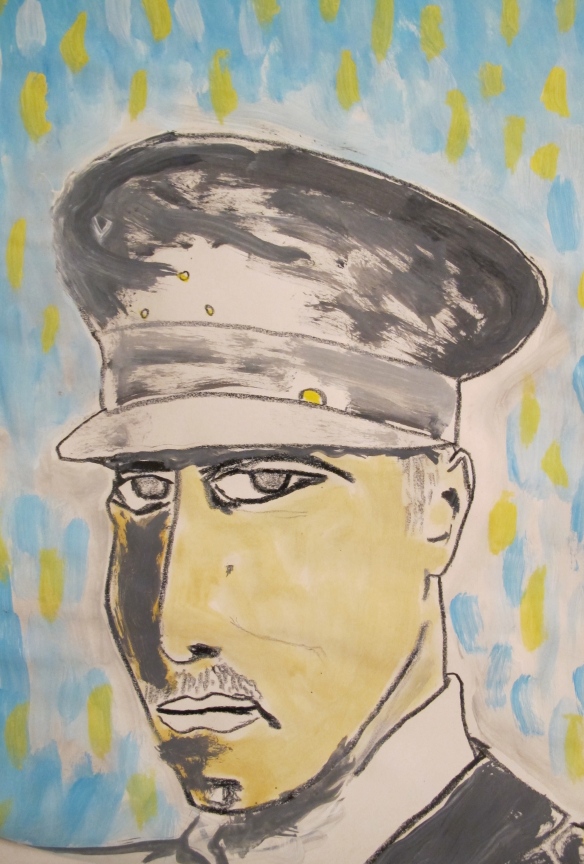
Wells, 'death-riding' at Station 18, shortly before his return to Private Military Service (PMS). It was at this time, sources say, that Wells was first approached by representatives from The Company, who offered him a position as a captain on one of its myriad deployments.
Recent FOIA petitions filed by the Flemish constabulary with federal agencies in the U.S. have yielded documents that describe a “radical deepening of mission-sense and core values” within The Company shortly before the time of Wells’ hiring.
(Readers of the Catastrophe will recall the illustrious history of The Company, the private military company founded in 1997 by Erik Prince and Al Clark [2][3] that is currently the largest of the U.S. State Department‘s three private security contractors. The Company provided diplomatic security services to the United States Federal Government in the first four Iraq wars on a no-bid contractual basis.[1] The Company’s current headquarters are located in Arlington, Va.; Kabul, Afghanistan; Yorba Linda, Ca.; Savannah, Ga.; Kingdom of Bahrain; Yamoussoukro, Ivory Coast; Quidobo, Colombia; Paso Robles, Ca.; Swat, Pakistan; Kirkuk, Iraq; Ft. Collins, Co.; and Ciudad Juarez, Mexico.)
Because of severe “optics” issues associated with every foreign country that it has ever served in, The Company has been forced to re-brand itself into a polyphony of subsidiaries and shadow companies.
Although C-1 Associated Security Services is perhaps the name that will be most familiar to non-military personnel, it is EIBON — a ghost-network within C-1 — that has won the majority of domestic contracts since Iraq 5. EIBON’s work in the emerging field of “Agricultural Security” has been particularly robust of late.

Newly recovered ship's logs now suggest that a terrifying supernatural presence may have made its way aboard the Nostromo. Authorities at Marine Safety and the CDC are said to be testing fuselage and hull remnants for traces of a heretofore unseen Corporate Virus [or, Formidable Non-Biological Entity known colloquially amongst epidemiologists simply as "Casino Fever.""

An unsettling ambiguity of origin has gathered around EIBON. ("Eibon," is known amongst religious scholars as a figure of indeterminate origin either as a "devouring cannibalistic demon" or as a "guardian of one or several of the seven gates to hell." Hermeneutical scholars have enjoyed centuries of interpretive debate over the import of the controversial symbol.)
Lindqvist and his colleagues at Dutch Marine Safety continue to chip away at blasted ship fragments returned from the Cap, but the ‘utter totality of the destruction’ and the ‘blistered state of the remains’ have caused the chief to grow almost philosophically reflective: “In all this ashen horror, I vaguely discern a subject — Wells, let’s say — who did what he thought was right for a very long time. One day he wakes up in a house of avaricious, mendacious cards and realizes that he has been entirely duped. After a period of joyous estrangement he goes into business with the very devil that betrayed him! Beyond this — I mean, whether he went into business purely for revenge or for some kind of personal gain — is difficult for me to sense at this time. I suspect it may have begun as one and then drifted into the other…” (Lindqvist went on for some time.)
Lager’s “Forever ’11″ fall fashion line fails to impress Erin Burnett with its “literalist stance.” As sartorial futures crash, Mercurial fashion designer said to be going to ground.
Authorities at the Fashion Institute of Technology (FIT) in New York have been trying for a month now to decode Chris Lager’s fall line, which debuted unseasonably late in October 2011, and was said to be marred by a “maddeningly erratic, almost willfully inscrutable” hand. Lager, who has long been revered for his steadfast, relatively traditional use of lines and palette, shocked FIT authorities when his “Forever ‘11” line hit the runways back in October.
Brent Lindqvist, a research assistant at FIT’s encryption lab, said that after running a series of inter-text algorithms on the Lager line, he became convinced that the clothes were “shockingly literal” and showed “the kind of unhindered intentionality one usually associates with plain speaking and logic.”
Monday’s DOW, which showed a 32-point dive in Lager futures, woefully confirmed Lindqvist’s dire prognostication. Jerry Handles, an associate sales associate at World’s End, Lager’s distributor, attempted to sum it up best: “The lack of distance between the stated claim and the intended claim is proving to be a hard sell for consumers in a season — an industry, really — infatuated with disparity.”
“Logic dictates,” Lindqvist went on to say, “That if we don’t hold ourselves apart then how are we to be considered, in the final analysis, to be truly, beautifully, singular?”
Lager has repaired to his Swiss retreat for the post-season. Insiders report that his winter line marks a return to the “Ronin-like, hatefully solitary style he is so loved for.”